634
Battle of Ajnadayn
The first major battle against Byzantium in Palestine, fought weeks before Abu Bakr died. It opened the road to Damascus.
17 battles and sieges from 634 to 838. Each links to its own page with the sides, the commanders, the result and a map.
The first major battle against Byzantium in Palestine, fought weeks before Abu Bakr died. It opened the road to Damascus.
The Muslims crossed a bridge of boats to face war elephants and were routed, and Abu Ubayd was killed. It was one of the worst defeats of the early conquests.
After a siege of about a month the city surrendered in September 634. The Muslims gave it up before Yarmouk and took it back for good in 636; in 661 it became the Umayyad capital.
Six days of fighting destroyed the Byzantine field army. Heraclius left Syria for good, and Damascus, Jerusalem and the whole Levant followed.
Over several days the Persian army and its war elephants were broken, and Rustam was killed. The Persian capital Ctesiphon fell the next year.
The Persian capital fell and its treasures were sent to Madinah. Yazdegerd III fled east and never returned.
The patriarch would only hand the city to the caliph himself. Umar travelled from Madinah, gave its Christians a written guarantee of safety, and prayed on the site of Al-Aqsa.
With Alexandria gone, Egypt and its grain passed to the caliphate. Amr founded Fustat, the camp city that later grew into Cairo.
Remembered as the victory of victories. The last great Sasanian army was destroyed and the Iranian plateau lay open. Nu'man was martyred in the battle.
Yazdegerd III was killed near Merv while on the run, ending a dynasty that had ruled Iran for over 400 years.
The first great sea battle in Islamic history. The new fleet built in Egypt and Syria beat the emperor's navy and ended Byzantine control of the eastern Mediterranean.
The fall of Carthage ended Byzantine rule in North Africa. Hassan then defeated the Berber queen known as al-Kahina, and the road to Spain lay open.
Qutayba's campaigns brought Bukhara and Samarkand into the caliphate, the start of Central Asia's long place in Islamic history.
A year-long siege by land and sea. Greek fire, a brutal winter and Bulgar attacks broke the army, and the city would not fall to a Muslim army for another 736 years.
The governor of al-Andalus was killed, and Arab writers called the field the Pavement of Martyrs. Raids north of the Pyrenees soon faded.
Kept Central Asia in the Muslim world. Tradition says Chinese prisoners taught papermaking in Samarkand, and paper soon reached Baghdad.
Al-Mu'tasim answered a Byzantine raid by sacking the home city of the emperor's family.
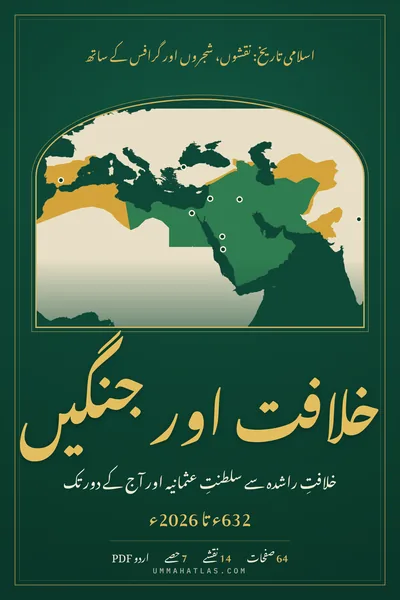
Khilafat aur Jangen puts this history in one Urdu PDF: 64 pages, 14 maps, family trees, charts and timelines from 632 to 2026.