Glossary
Words you will meet in Islamic history
From amir to waqf: 38 short definitions of the titles, terms and institutions used across this atlas.
38 of 38 terms
- Ashura
- The 10th of Muharram, the day Husayn was martyred at Karbala in 680.
- Amir
- Commander or prince. Amir al-Mu'minin, Commander of the Faithful, was a title of the caliph.
- Atabeg
- A Turkish guardian of a young prince, who often became the real ruler. Zengi was atabeg of Mosul.
- Bay'ah
- The pledge of allegiance given to a new ruler.
- Caliph (khalifa)
- Successor. The title of the leader of the Muslim community after the Prophet, combining government with the duty to uphold the faith.
- Caliphate (khilafah)
- The state or office led by a caliph.
- Devshirme
- The Ottoman levy of Christian boys from the Balkans, who were converted and trained for the army and government.
- Dhimmi
- A protected non-Muslim subject of a Muslim state, with rights to life, property and worship.
- Diwan
- A register or government office. Umar's diwan listed soldiers and their pay; later the word meant a ministry or council.
- Fitna
- Trial or strife. The name for the civil wars among Muslims: the first from 656 to 661, the second from 680 to 692, and later ones.
- Ghazi
- A warrior on the frontier. The early Ottoman rulers used the title.
- Haram al-Sharif
- The Noble Sanctuary in Jerusalem, which contains Al-Aqsa Mosque and the Dome of the Rock.
- Hijrah
- The Prophet's migration from Makkah to Madinah in 622, year 1 of the Islamic calendar.
- Hijri calendar (AH)
- The lunar Islamic calendar counted from the Hijrah and introduced by Umar. A Hijri year is about 11 days shorter than a solar year.
- Ilkhanate
- The Mongol state founded by Hulagu in Iran and Iraq. Its ruler Ghazan converted to Islam in 1295.
- Janissary
- From yeni ceri, new soldier: the Ottoman standing infantry, recruited through the devshirme and abolished in 1826.
- Jizya
- A tax paid by non-Muslim subjects in return for protection and exemption from military service.
- Kharijites
- Those who went out: the group that left Ali after the arbitration at Siffin and declared their opponents unbelievers.
- Madrasa
- A college for religious and legal study. The Nizamiyya colleges of the Seljuk era were famous early examples.
- Mamluk
- Owned. Slave soldiers, mostly Turks and Circassians, trained from youth. In Egypt they took power and ruled as sultans from 1250 to 1517.
- Mandate
- A League of Nations arrangement after the First World War under which Britain and France ruled former Ottoman lands.
- Mawali
- Non-Arab converts attached to Arab tribes. Their unequal treatment under the Umayyads fed the Abbasid revolution.
- Mihna
- The trial begun by al-Ma'mun in 833 to make scholars accept that the Quran was created.
- Nakba
- Catastrophe. The displacement of about 700,000 Palestinians in 1948.
- Qadi
- A judge of Islamic law.
- Qibla
- The direction of prayer. Jerusalem was the first qibla before it changed to the Kaaba in Makkah.
- Rashidun
- Rightly guided. The first four caliphs: Abu Bakr, Umar, Uthman and Ali.
- Reconquista
- The centuries-long conquest of Muslim Spain by the Christian kingdoms, completed with Granada in 1492.
- Ridda
- Apostasy. The Ridda wars of 632 and 633 brought the breakaway tribes of Arabia back under Madinah.
- Shia
- From shi'at Ali, the party of Ali: Muslims who hold that leadership belonged to Ali and his descendants.
- Shura
- Consultation. Umar's council of six, which chose Uthman, is the classic example.
- Sultan
- Authority. From the 11th century the title of rulers who held real power, often in the caliph's name.
- Sunni
- From ahl al-sunnah wal-jama'ah: the majority of Muslims, who accept the first four caliphs in their historical order.
- Taifa
- A faction. The small rival kingdoms of al-Andalus after the caliphate of Cordoba collapsed in 1031.
- Ulama
- The scholars of Islamic religion and law.
- Ummah
- The worldwide community of Muslims.
- Waqf
- A charitable endowment. The Al-Aqsa compound is run by the Islamic Waqf of Jerusalem.
- Wazir (vizier)
- Chief minister. The grand vizier ran the Ottoman government for the sultan.
No term matches. Try a shorter word.
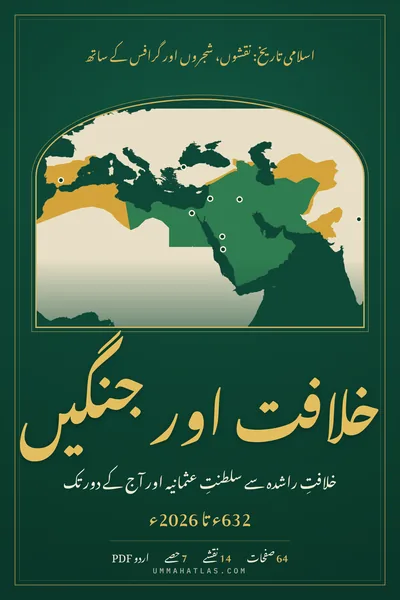
The book, 75% off
Read the whole story in Urdu
Khilafat aur Jangen puts this history in one Urdu PDF: 64 pages, 14 maps, family trees, charts and timelines from 632 to 2026.
$1.50$6.0075% off